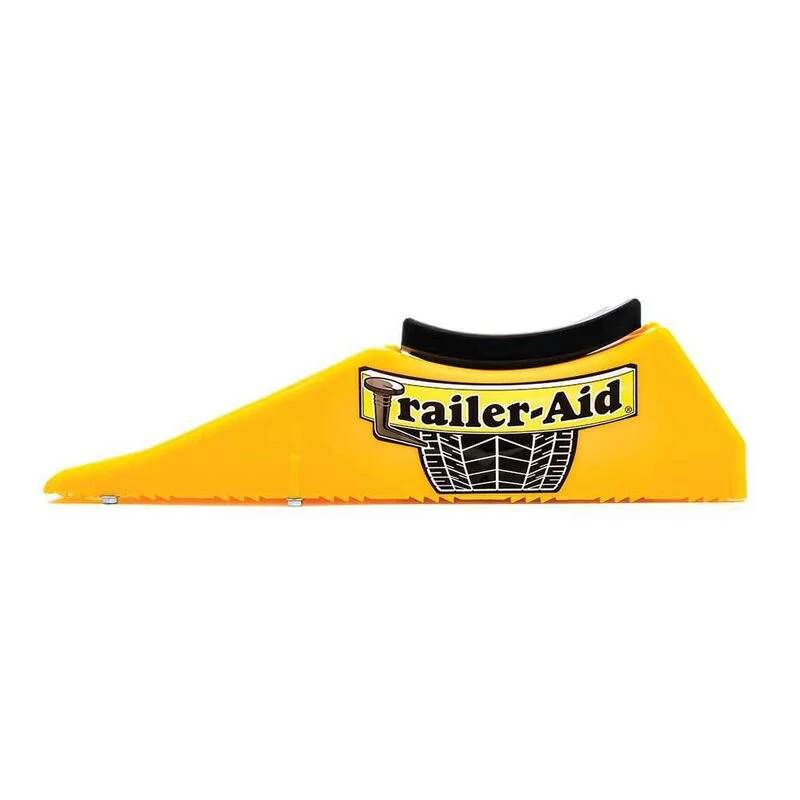

Trailer Aid: Must Have Gear
As an RV traveler, there are a few tools that earn a permanent spot in the front bay, and Trailer Aid is one of them. It’s a simple plastic ramp designed for tandem-axle trailers that turns a stressful roadside tire change into a quick, controlled pit stop instead of a wrestling match with a jack.
What Trailer Aid Is and How It Works
Trailer Aid (and the Trailer Aid Plus) is a heavy-duty polymer ramp built to lift one wheel of a tandem-axle trailer by driving the other wheel up onto the ramp. It’s typically rated up to around 15,000 lbs of trailer weight, with some curved models going up to 20,000 lbs, which puts most fifth-wheels squarely in its comfort zone. The one-piece design won’t rust, has no moving parts to fail, and is light enough to move with one hand, yet sturdy enough to cradle a loaded axle.
In real-world use, the idea is simple: the good tire on the affected side rolls up into the molded “cup” at the top of the ramp, and the flat tire on the same side lifts clear of the ground so you can swap it. I’ve found that, when everything goes smoothly, you can be back on the road in five to ten minutes instead of crawling around under the rig fighting with a bottle jack on a sketchy shoulder.
Can Trailer Aid Handle a Heavy Fifth-Wheel?
The short answer is yes—within its limits, Trailer Aid is well-suited for most tandem-axle fifth-wheels. The standard Trailer Aid/Trailer Aid Plus is rated around 15,000 lbs GVW, and the newer curved versions are rated for trailers up to about 20,000 lbs, supporting up to 9,000 lbs on the lifted axle. Many fifth-wheel owners report using it on rigs in the 9,000–15,000 lb range for flats, bearing checks, and brake work without needing to unload the trailer.
Where you need to be cautious is at the extremes. Heavier fifth-wheels near or above that 15,000 lb mark, or those with spread axles or certain upgraded suspensions, can run into two issues: the load rating and the amount of lift. The ramp typically gives about 4.5–5.5 inches of lift; on some spread-axle or modified suspensions, that may not quite get the flat fully off the ground. In that case, you may need the higher-rated curved model or a backup jack strategy, especially if your per-axle weights run high.
Positioning Trailer Aid for a Fifth-Wheel Tire Change
Getting the setup right is what makes Trailer Aid feel safe, stable, and drama-free. The mantra is: “good tire on the ramp, flat tire in the air,” with everything straight, level, and chocked.
Here’s the basic process I follow with a fifth-wheel:
1. Prep and secure the rig
• Park as straight and level as the situation allows, set your parking brake, and put the truck in park.
• Turn on hazard lights, set out triangles if you have them, and chock the opposite side of the trailer—front and rear of at least one tire.
• Slightly loosen the lug nuts on the flat tire while it’s still on the ground, but don’t remove them yet.
2. Place the Trailer Aid correctly
• Identify which tire is flat—front or rear on that side.
• Place the ramp under the good tire on that side, with the low, tapered end facing the direction you plan to move.
• If the rear tire is flat, the ramp goes under the front tire.
• If the front tire is flat, the ramp goes under the rear tire.
• Center the good tire with the ramp so it climbs straight into the molded cup and not off the edge.
3. Drive up and lift the flat
• Gently pull forward or back so the good tire climbs the ramp and settles fully into the cup.
• Once it’s seated, stop, shift to park, and re-check your chocks.
• Confirm the flat tire is clearly off the ground and spins freely; on some suspensions, you may need a solid board under the ramp for a bit more lift, but only on firm, stable ground.
4. Swap the tire and lower
• Remove the loosened lug nuts, pull the flat, and install the spare, snugging the nuts in a star pattern while the tire is in the air.
• Slowly roll off the ramp until the good tire is back on the ground, then re-torque the lug nuts to spec.
• Pull your chocks and gear, do a final walk-around, and you’re good to roll.
Used this way—with the good tire centered on the ramp, the fifth-wheel on reasonably firm ground, and the opposite side thoroughly chocked—Trailer Aid feels solid and predictable, even with a heavy rig.
What I Like (and What to Watch)
For me, Trailer Aid hits the sweet spot between simplicity and safety:
• No jack gymnastics: Not having to crawl under a loaded fifth-wheel and hunt for jack points on gravel or a soft shoulder is a huge confidence booster.
• Compact and multipurpose: It’s light, easy to store, and can double as a sturdy wheel chock in camp, so it’s not just riding along for emergencies.
• Strong but user-friendly: For something that can lift a loaded axle on a big trailer, it’s surprisingly easy to carry and position.
On the flip side:
• It only works on multi-axle rigs—single-axle trailers still need a traditional jack.
• Axle spacing and suspension design can limit how high the flat comes off the ground, so it’s worth testing at home before you need it on a shoulder.
• It doesn’t replace good roadside safety habits; you still need chocks, triangles, and common sense about where you stop.
Final Take for RV Travelers
As an RV travel blogger and tower, I consider Trailer Aid part of my core “must-have” gear, right up there with a torque wrench and a good tire gauge. For most tandem-axle fifth-wheels, it’s a fast, stable way to get a flat off the ground without wrestling a jack under a heavy rig on the side of the highway. It’s not magic—you still have to respect weight ratings, axle spacing, and basic safety—but when a tire does go, this little ramp can turn a trip-ruiner into a quick, controlled pit stop and get you back to the fun part of RV travel.